Below are several blurbs and articles gleaned from available info pertaining to EHV-1.
We will update as we get new pertinent information.
Caveat/disclaimer: other than Clemson LPH information (verifiable), SCHC is not responsible for the content of any gleaned information from public media or any other sources; confirmed or unconfirmed. We are only providing you with information.
According to EDCC, 27 cases are now associated with the ehv outbreak.
The EDCC is the stalwart of equine disease notification for the US. If you want to know the real information, not Facebook falderol, this is the place a Vet will look.
The following is an embedded alert directly from EDCC. Since it is live, it may change as they update.
While the information is there, it may be a little difficult find exactly what you are looking for unless you already know where it is. See the Equus Magazine below for some relative semblance of clarity.
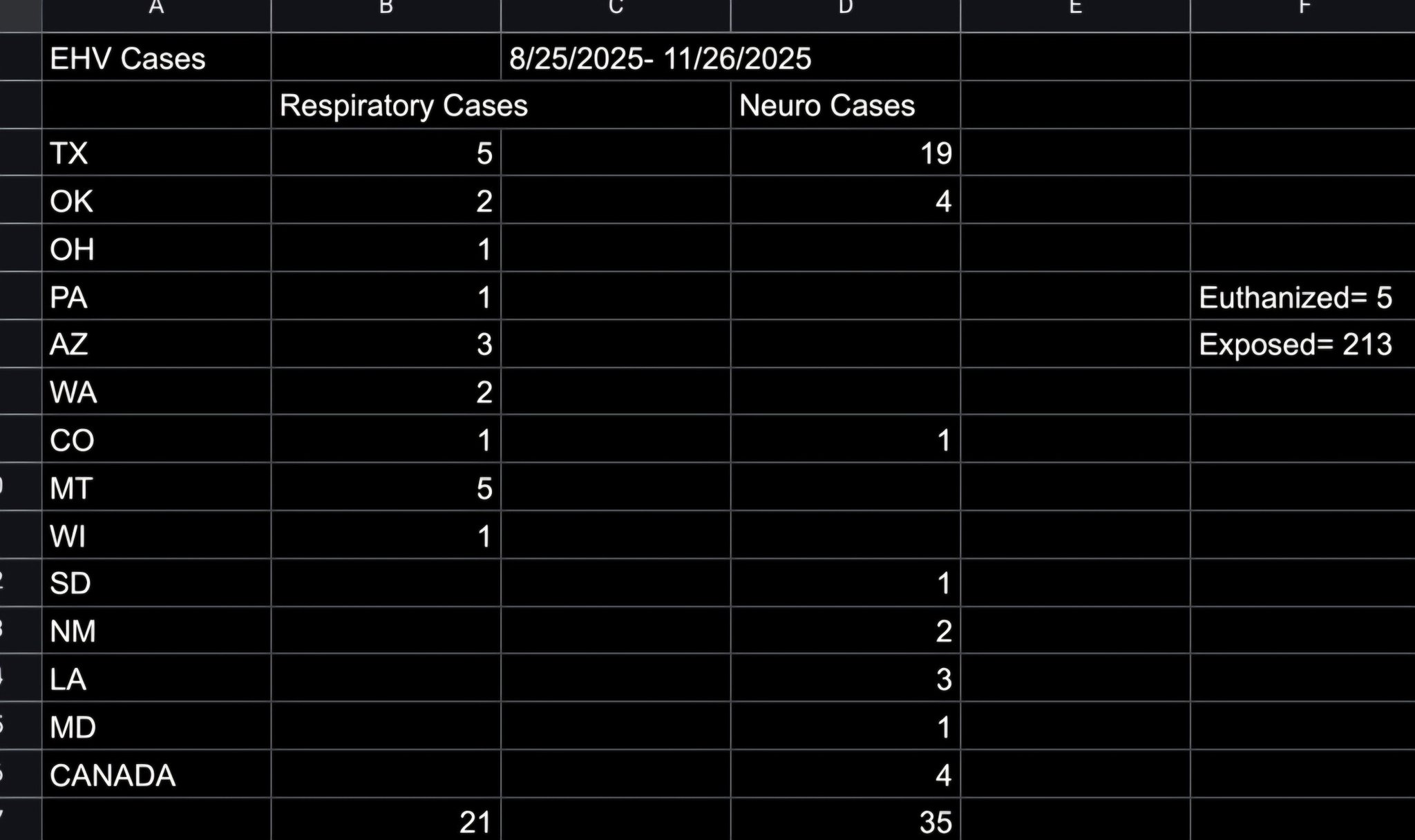
The following is an embedded alert directly from Equus Magazine with reports from the EDCC.
The magazine a deciphered many of the EHV articles to make it easier to read. Since it is live, it may change as they update. You may have to close popup messages as well.
I’m sure everyone has caught wind of the EHV-1/EHM outbreak in Texas and Oklahoma. I was on a national call today and learned the current extent and the ripple effects of it.
The outbreak originated at the WPRA/Elite Barrel Race event in Waco, Texas. That show was held November 5-9. Two horses became clinical a week/10 days later and the Texas State Vet was notified on 11/18. There were 670 horses at that event. Then a lot of those horses traveled north to Oklahoma to the Barrel Futurity of America (BFA) show at the Lazy E Arena is Guthrie, Oklahoma, where there were 1200 horses. 2 horses began showing clinical signs at the show and were transported to Oklahoma State University College of Veterinary Medicine for treatment and isolation.
Both Texas and Oklahoma are actively working to find the traces of where horses went AFTER those shows. I am sure some came to SC. And we will work on those as they come. Currently, there have been 2 confirmed cases in TX, 2 confirmed cases in OK, 1 confirmed case in Arkansas, and 3 cases in Louisiana (transfers from Texas A&M Vet school to LSU CVM due to lack of isolation space). New Jersey is also waiting on confirmation of one more case.
At the show in Waco, TX, 30 states were represented, as well as 4 Canadian provinces. At the Oklahoma show, 28 states were represented, as well as 4 Canadian Provinces. I am sure there will be traces to SC, and I will investigate/quarantine those as needed.
https://www.clemson.edu/public/lph/
WEF, WEC and HITS Community Alert
Whitney Caldwell
The Emerging Role of PEPTIDES in EHV-1 Prevention and Treatment
A devastating outbreak of neurologic EHV-1 traced to the WPRA Finals in Waco, Texas, has already claimed AT LEAST 15 lives (unconfirmed at this time) with hundreds exposed and canceled events across the state. While valacyclovir remains the only licensed antiviral for EHV-1, a growing body of research points to an entirely new class of weapons: peptides. These short chains of amino acids — some naturally produced by the horse itself, others designed in the lab — are showing remarkable antiviral and immunomodulatory effects against EHV-1 and related viruses.
Our current arsenal is not enough.
• Current tools (vaccines, valacyclovir, strict biosecurity) reduce but do not eliminate risk. Modified-live vaccines can still allow viral shedding; killed vaccines give poor cell-mediated immunity.
• Neurologic form (EHM) still carries 20–30 % mortality in some outbreaks.
• No true antiviral exists that is safe for long-term or prophylactic use.
Peptides Already Being Studied for EHV-1 and Related Equine Viruses:
A. Equine Cathelicidins (natural peptides horses already make)
• eCATH1, eCATH2, and especially eCATH3 are secreted in the respiratory tract.
• 2023–2025 studies (Vet Immunol Immunopathol, Front Vet Sci) show synthetic analogs kill enveloped viruses (including herpesviruses) on contact and stimulate protective IFN responses.
• Vitamin D3 upregulates equine cathelicidins — researchers are testing oral 25-OH-D3 supplementation as a cheap way to boost natural peptide levels before events.
B. NK-Lysin-derived peptides
• 2024 paper (Viruses) found horses that rapidly upregulate NK-lysin after EHV-1 exposure have shorter viremia and almost no neurologic signs.
• Synthetic 30-aa NK-lysin fragments are in preclinical safety testing for intranasal delivery.
C. Defensin-inspired peptides (equine β-defensins 1–3, DEFB103B analogs)
• Broadly neutralize herpesviruses by preventing fusion with host cells.
• A 2025 pilot at UC Davis showed a single intranasal dose reduced EHV-1 shedding by 2.3 log in experimentally challenged ponies.
D. Lab-designed entry inhibitors
• Short peptides mimicking the EHV-1 gB or gD binding domains block receptor attachment.
• Cornell 2024–2025 work (J Virol) identified a 22-mer peptide that reduced viral plaque formation by 94 % in equine endothelial cells — the exact cells damaged in EHM.
E. Peptide-conjugated phosphorodiamidate morpholino oligomers (PPMOs)
• Already proved curative in equine arteritis virus (EAV) persistent infection models.
• EHV-1-specific PPMOs are in late preclinical stage at Colorado State University (expected equine trial 2026).
Prophylactic Use: The Holy Grail
• Unlike valacyclovir (which must be given early in infection and is expensive at treatment doses), many peptides are stable, non-toxic, and can be given days to weeks ahead of high-risk events.
• Example protocol being trialed in Europe (2025 data not yet published):
Intranasal cathelicidin analog + oral vitamin D3 booster 7–10 days before shipping to a show → measurable increase in respiratory mucosal peptide levels for ~21 days.
Safety & Practical Considerations
• Peptides generally cause no injection-site reactions and are poorly immunogenic (horses don’t make antibodies against them).
• Biggest hurdles right now: cost of GMP-grade synthetic peptides and short half-life of some sequences (being solved with D-amino acid mirrors and lipidation).
What Owners and Trainers Can Do Today
1. Ask your veterinarian about off-label use of high-dose vitamin D3 protocols (already legal and inexpensive) to boost natural cathelicidins.
2. Monitor clinical trial databases (e.g., ClinicalTrials.gov, EVJ, AAEP proceedings 2026) for upcoming peptide studies recruiting client-owned horses.
3. Support biosecurity — peptides will be an additional tool, not a replacement.
“Ten years ago we had almost nothing once a horse spiked a fever with EHV-1. Today we have valacyclovir, and tomorrow we may have safe, affordable peptides that prevent the virus from ever taking hold.”
— Dr. Nicola Pusterla, UC Davis, November 2025 AAEP pane
Bend Equine blurb (Oregon)
Many of you may have heard of an EHV-1 outbreak in Texas and Oklahoma. Because the initial (index) case occurred following the World Championship Barrel Racing Finals in Waco, TX, many unknowingly exposed horses travelled back to their home states or on to other events, unfortunately potentially allowing the outbreak to become widespread. EHV-1 can have an incubation period of up to 14-21 days.
Please be aware that some states may be cancelling 6 month travel passports or may have stricter than typical import requirements; if you have planned upcoming travel with your horse, you should check with the state of destination for the latest information.
Our state veterinarian made an announcement today with the following information:
The Oregon State Veterinarian’s Office has been made aware of an outbreak of Equine Herpes Virus (EHV)/ Equine Herpes Myeloencephalopathy (EHM) in horses that were at or associated with barrel racing and rodeo-type events in Texas and Oklahoma. Several cases of EHM have been confirmed in Texas and Oklahoma associated with these equine events, with numerous reports of additional cases and equine deaths pending investigation.
We do not have any confirmed cases of EHV/EHM in Oregon at this time. Our office is coordinating with the affected states and we are currently awaiting to receive trace information from Texas and Oklahoma. If we receive traces from the other states, we will contact those owners directly and issue quarantine orders to mitigate further spread of the disease.
This outbreak serves as a reminder of the potential disease risks associated with large commingling equine events. It underscores the importance of timely reporting of diseases and ensuring that movement requirements are followed, including veterinary inspection and health certificates prior to travel.
Recommendations for Horse Owners
If you have clients with horses that traveled to Texas, Oklahoma, or other equine events where EHV exposure may have occurred, please contact our office directly at 503-986-4711. We will provide guidance regarding isolation and monitoring:
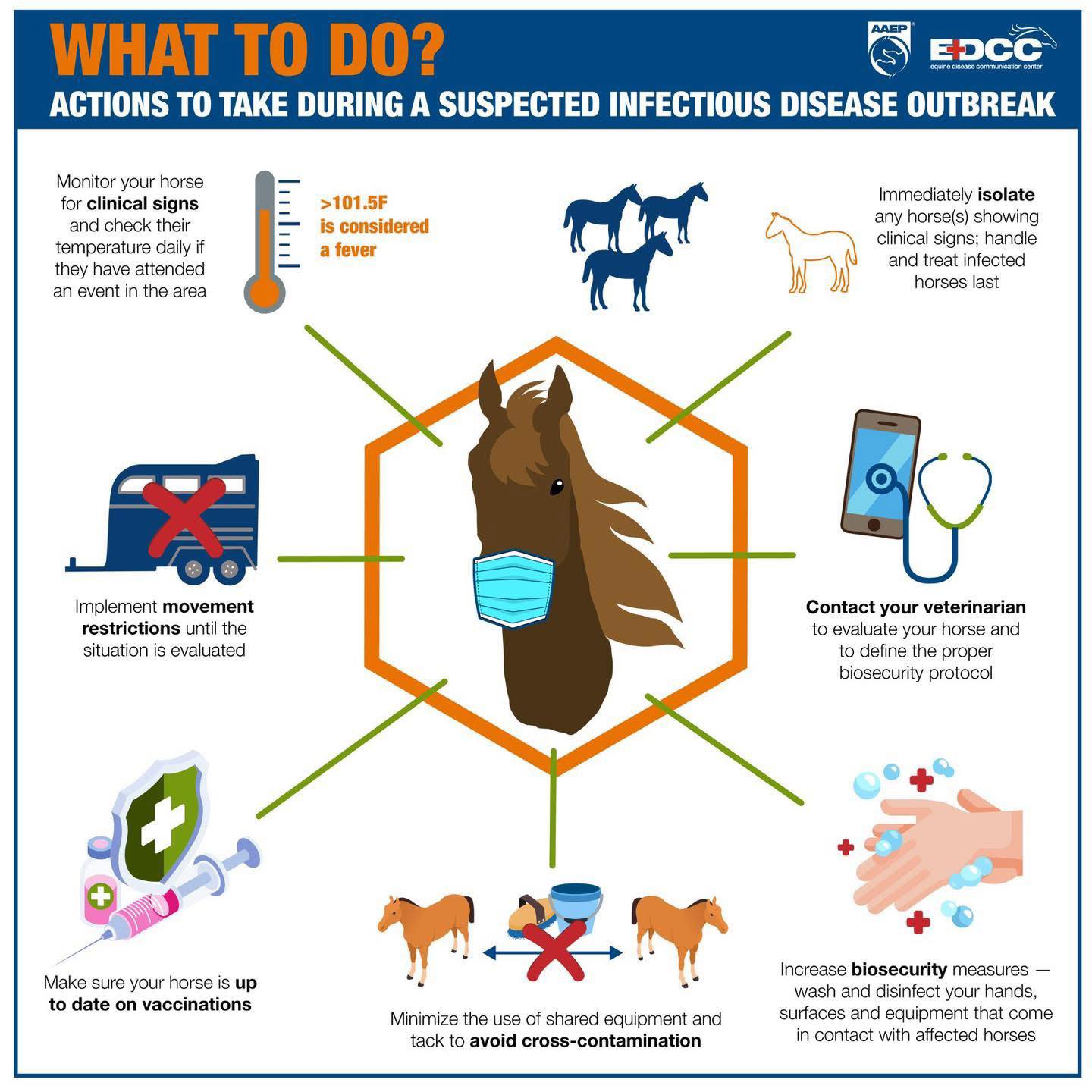
Exposed horses should be isolated for 21 days after last known exposure.
Appropriate isolation includes restricted access to other horses, avoiding the sharing of equipment or personnel, and utilization of protective barrier precautions.
Exposed horses should be monitored twice daily for elevated temperature (above 101.5*), respiratory signs (nasal discharge, coughing), and for clinical signs consistent with equine herpes myeloenceophalopathy (neurologic symptoms including inability to stand, difficulty walking, lethargy, and urine dribbling).
If elevated temperature, respiratory signs, or EHM-compatible clinical signs are noticed, owners should contact their veterinarian.
Upcoming Equine Events
Equine herpes virus can be shed for prolonged periods of time, including in clinically healthy horses, which increases risk for continued disease spread during a EHV/EHM outbreak.
Event Organizers: We recommend event organizers consult with their designated show veterinarian and understand the risks associated with hosting equine events during a multi-state outbreak. Cancellation or postponement of events may be important to stop continued spread of disease. If events do take place, we recommend short-timed health certificates within 72 hours and increasing biosecurity practices on site. Additional requirements for equine exhibitions may be implemented based on risk.
Interstate Movement
Please note that many states may be implementing movement restrictions or new import requirements for equines during this outbreak. Please always check with the state of destination to ensure that you are following import restrictions.
Equine Herpes Virus Information
EHV‐1 is spread from horse to horse through contact with nasal discharge or spread as aerosol droplets. Infected horses may not show clinical signs of the virus but may still act as carriers. Horses can also contract the virus by coming into contact with contaminated surfaces such as stalls, water, feed, tack, and transport vehicles. People can spread the virus from horse to horse by contaminated hands and clothing. It is important for owners to watch for signs and symptoms and practice biosecurity measures. Good biosecurity practices include extensive cleaning and disinfection of surfaces and equipment that come in contact with affected horses, and individuals who treat or come into contact with infected horses need to follow appropriate disinfection protocols when handling multiple horses.
The Oregon Department of Agriculture State Veterinarian’s Office Disease Reporting Hotline may be reached any time at 503-986-4711.
Katherine Rowley public announcement
There is a major Equine Herpesvirus-1 (EHV-1) outbreak happening right now, and it is not the kind of thing you can “hope away” with positive thoughts. This virus is extremely contagious, spreads in more ways than people realize, and is already responsible for sickness and death across the country.
Before anyone panics or says “but my horse looks fine,” here’s what everyone needs to understand:
🔬 HOW EHV-1 SPREADS (AKA: HOW THE VIRUS WINS WHEN WE GET LAZY)
• Airborne droplets: A cough, a snort, or a friendly nose-boop between horses can move the virus. It’s basically the world’s rudest sneeze.
• Direct contact: Nose-to-nose greetings = viral speed-dating.
• Indirect contact: Buckets, grooming tools, tack, halters, lead ropes, hands, clothing, boots… if it exists, a horse can sneeze on it, and boom it’s contagious.
• PEOPLE CAN SPREAD IT:
You don’t have to touch a horse to carry the virus from one barn to another. Your clothes, your gear, and even your car can play Uber for pathogens.
• Latency: Horses can carry EHV-1 silently. They may look totally normal while shedding the virus like it’s free confetti.
⏱️ THE SCARY TIMING PROBLEM
• Incubation: 2–10 days (your horse can spread it before looking sick)
• Shedding: 7–10 days, sometimes up to 28 days
• Horses can be asymptomatic, meaning they’re contagious with zero warning signs
• Stress (travel, training, PEMF, shows) can reactivate the virus in carriers
Translation: “Cutting back on barn visits” won’t magically protect your herd.
⚠️ IF YOU WORK IN THE EQUINE INDUSTRY, PLEASE READ THIS TWICE
Trainers, PEMF practitioners, massage therapists, chiropractors, farriers, bodyworkers, photographers, and anyone bouncing between barns:
Reducing your workload is NOT the same as proper biosecurity.
If you have horses at home, simply doing “fewer barns” will not eliminate your risk to your personal horses and others.
If you have horses at home and you are touching multiple outside horses the exposure potential skyrockets.
Professionals with horses on their property should consider temporarily suspending multi-barn travel unless biosecurity is airtight. One contaminated halter, one sneeze, one forgotten sleeve rub… that’s all it takes.
Meanwhile, photographers (like me) who don’t handle horses directly and don’t keep horses at home have a significantly lower transmission risk but even then, I am limiting myself to one barn per day and disinfecting between shoots, because biosecurity is everyone’s responsibility.
😬 WHY THIS MATTERS: THE NEUROLOGIC FORM (EHM)
EHV-1 can turn into a neurologic form called EHM.
That’s the one that causes:
• Incoordination
• Hind-end weakness
• Loss of bladder/tail control
• Inability to stand
• And in severe cases, euthanasia
This is why barns are locking down. This is why events are being cancelled. This is why people are scared. And honestly? They should be.
🧼 WHAT WE ALL SHOULD BE DOING RIGHT NOW
• Limit barn-to-barn travel
• Change clothes and disinfect boots between locations
• Keep separate equipment per barn
• Wash hands after every horse interaction
• Do not share buckets, tools, tack, cross-ties, or the sacred communal barn brush
• Isolate any horse that has traveled, even if they look fine
• Take temperatures twice daily
• Communicate honestly no secrecy, no pride, no “it’s probably fine”
💬 BOTTOM LINE
This outbreak is serious. It spreads fast, it hides well, and it’s absolutely capable of wiping out thousands of horses if people aren’t careful.
Biosecurity is not optional.
Transparency is not optional.
And “doing a little less” is not enough.
Protect your horses. Protect other people’s horses. STOP SHOWING, STOP TRAVELING, STOP HAULING OUT.